IIGR Technologies:
Seed treatment in groundnut immediate before sowing
Order of seed treatment – FIR (Fungicide – Insecticide – Rhizobium)
Seed treatment with Fungicide + Insecticide – Combined mixture of fungicide and insecticide is available in the market. (Imidacloprid 18.5% + Hexaconazole 1.5% FS @ 2.0 ml per kg seed). Treat the seeds by this slurry prepared by dissolving this combined mixture in recommended quantity of water (@2ml chemical in 6ml of water for 1 kg seed) and shade-dry for 2 hrs. (Trade name IMIDACLOPRID + HEXACONAZOLE – Neonix)
Seed treatment with Rhizobium –
Prepare slurry by dissolving 500 g of sugar in 500 mL of water
Heat the solution for 15 minutes
Add 200 g gum arabica and cool to room temperature
Place the treated seeds in the seed drum
Add either Rhizobium (1.25 kg ha) and rest it for 15 minutes
Spread the treated seeds on cement floor or plastic sheet and shade-dry for 30 minutes
Sow the seeds in furrow and provide irrigation immediately.
Micronutrient application in groundnut
Nutrient management: FYM 5 t/ha, 12.5-25-50 kg NPK/ha (100% N-P and 50% K as soil application as basal and 50 % K at 45 DAS).
Soil and/or foliar application of micronutrients if soil test values are found deficient for micronutrient(s):
| Micronutrient | Form and rate of application to soil | Application as spray |
| Boron | Borax 5-10 kg/ha | 2.5gm/ litre borax |
| Copper | Copper sulphate 5-10 kg/ha | 1 gm/litre copper sulphate + 0.5 gm/litre lime |
| Manganese | Manganese sulphate 10-25 kg/ha | 6 gm/litre manganese sulphate + 3 gm/litre lime |
| Zinc | Zinc sulphate 15-25 kg/ha | 5 gm/litre zinc sulphate + 2.5 gm/litre % lime |
| Molybdenum | Ammonium molybdate 0.5-1.0 kg/ha | 0.1 gm/litre ammonium molybdate |
| Iron | Ferrous sulphate 25-50 kg/ha | 10 gm/litre ferrous sulphate (thrice)+ 5 gm/litre lime |
Integrated weed management in groundnut
Pre-emergence application: Diclosulam 84% WDG @26 g/ha (within 03 days – 72 hrs of sowing)
Post-emergence application: Quizalopfop ethyl 5% EC @50 gm/ha or Imazethyper 10% SL @100 gm/ha to the crop at 20-25 days of crop emergence or at 3 to 4 leaf stage of weeds.
Interculture for aeration once or twice after 7-10 days of application of post-emergence herbicide (or 25-30 days after pre-emergence application, if post emergence is not applied)
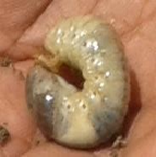
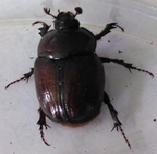
White grub management in groundnut
Installation of light traps for adults of white grub.
Installation of pheromone traps on host trees like neem, moringa, subabul for mass attraction and killing by spraying systemic insecticides (chlorpyriphos, imidacloprid) on host trees.
Seed treatment with Imidacloprid (48 FS @2ml/ kg of seeds) or chlorpyriphos (20 EC @12 ml/kg seeds).
If fields infestation with white grub is observed drenching the root zone with Chlorpyriphos.
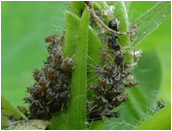
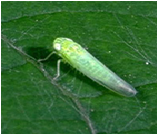
Management of Sucking Pests in groundnut:
- Border crop: 3-4 rows of pearl millet or sorghum
- Seed treatment: imidacloprid 600FS @ 3 g or thiamethoxam 30FS @ 6 mL per kg of seeds
- Yellow or blue sticky traps: 40/ha
- Spray commercial formulation of Verticillium lecanii @ 2.5 kg/ha
- Foliar spray: neem seed kernel extract 25kg or neem oil 2.5L per ha
- Foliar spray: imidacloprid 17.8SL @ 125 mL/ha or chlorpyrifos 20EC @ 1 L/ha ~25 days after sowing.
 |
 |
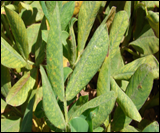 |
| Aphids | Leaf Hoppers | Thrips |
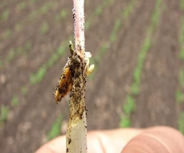
Management of Soil Borne Diseases in groundnut
- Seed treatment with Tebuconazole 2% DS @1.25 g/kg seed or Imidacloprid 18.5% + Hexaconazole 1.5% FS @ 2.0 ml per kg seed or Carbendazim 12% + Mancozeb 63% WP 2.5 g/kg seed or Carboxin 37.5% + Thiram 37.5% WS 2g/kg seed
- Soil application of Trichoderma spp @4kg per hectare along with500 kg well decomposed FYM or castor cake.
Major Diseases and Pests in Groundnut
 |
 |
 |
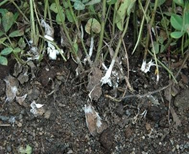 |
| White grub larvae | White Grub (Adult) | Collar rot | Stem rot |
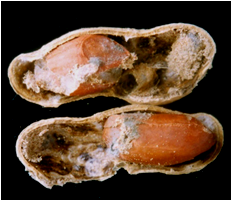
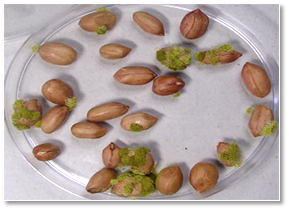
Management OF Aflatoxin in groundnut:
- Soil application: neem or castor cake @ 500 kg/ha 7-15 days before sowing
- Avoid end-of-season drought by providing supplemental irrigation
- Harvest the crop at right maturity
- Avoid mechanical damage to the pods during harvesting
- Dry the uprooted plants in small heaps by keeping them upside down
- Dry pods to <8% moisture level before storage
- Do not mix leftover pods with main produce
- Avoid spray of water before decortication/shelling
 |
 |
Bio formulations prepared by ICAR-IIGR
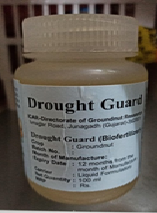
Drought guard (Bacillus firmus J22N)
Drought guard is a bio-formulation developed to help crops withstand water scarcity. It improves root growth, enhances potassium uptake, and supports photosynthesis, thereby strengthening the plant’s ability to cope with stress. Farmers can save nearly 30% irrigation water while still gaining a yield increase of up to 25%. The technology is economical, long-lasting with a shelf-life of over two years, and can be applied easily through irrigation water, FYM, seed treatment, or drip systems. It has been successfully used in groundnut, chickpea, soybean, cotton, and other legumes, improving farm income by about 25%.
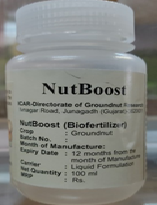
Nut boost (Consortium of PGPRs)
Nut boost is a microbial consortium designed to promote groundnut growth and soil health. It works by solubilizing and mobilizing nutrients such as phosphorus, potassium, nitrogen, iron, and zinc, making them more available to plants. Besides enhancing yield by up to 18%, NutBoost helps in reducing soil-borne fungal pathogens like Sclerotium rolfsii and Aspergillus niger. The formulation is cost-effective, stable for more than a year at room temperature, and can be applied through irrigation water, FYM, drip systems, or as a seed treatment, making it farmer-friendly and reliable.
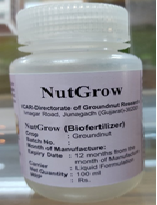
Nut grow (DAPG-Producing Fluorescent Pseudomonads)
Nut grow is an advanced microbial product that promotes crop growth while suppressing diseases. It has shown to improve groundnut yield by around 21% and significantly reduce collar and stem rot by nearly 60%. NutGrow enhances nutrient availability in the soil, especially phosphorus, potassium, manganese, iron, and zinc, by 20–25%, and also helps control nematodes. By reducing the need for external fertilizers by about 30%, it lowers input costs while improving productivity. With a shelf-life of over one year and easy application through seed treatment, irrigation water, or FYM, Nutgrow is a sustainable solution for farmers.
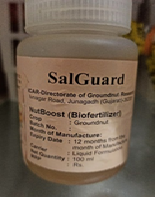
Sal guard (Endophytes for Salinity Stress)
Sal guard is a microbial formulation developed to alleviate the adverse effects of salinity stress on crops. By stimulating root growth, regulating nutrient uptake, and producing growth hormones like IAA and ACC deaminase, it helps plants maintain normal physiological functions even under saline conditions. The use of Salguard leads to yield advantages of up to 25% and improves farmers’ income by the same margin. With a shelf-life of more than two years, the product can be applied through irrigation water, FYM, seed treatment, or drip systems. Its broad crop suitability makes it valuable for groundnut, pulses, and oilseeds.
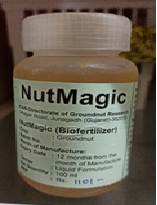
Nut Magic (Bacterial Consortium)
Nut magic is a unique bacterial mixture combining PGPR, PSB, and Rhizobia for boosting groundnut yield and soil fertility. It enhances nutrient uptake of nitrogen, potassium, zinc, manganese, and iron by 7–10%, while also fixing up to 200 kg nitrogen per hectare annually. The technology reduces the need for phosphorus fertilizer by half and cuts down overall input costs by 25–30%. Nutmagic not only supports crop growth through natural hormones like IAA and gibberellins but is also compatible with common seed treatment chemicals. It is suitable for kharif and summer cultivation, available in liquid, charcoal, peat, and talcum formulations, and has a shelf-life of over one year.
 |
 |
 |
 |
 |
| Drought guard | Nut Boost | Nut Grow | Sal Guard | Nut Magic |



 Views Today : 195
 This Month : 18329
 This Year : 69894
 Total views : 3219055