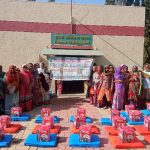
Front Line Demonstrations (FLDs)
At various AICRPG centers, a total of 11632 demonstrations were conducted in Kharif and in Rabi/Summer since 1998 and since 2000-2001, there were 11237 (Table 1) demonstration on improved package of practices including integrated disease and pests management, integrated nutrient management, integrated weed management, water management, biofertilizers, biocontrol agents, improved varieties, and whole package.
Table 1. Impact of improved package of practices on productivity of groundnut
| Year | Total No. of FLDs conducted | Improved practice pod yield (Kg/ha) | Farmers old practice pod yield (Kg/ha) | Increase in yield over farmers practice (%) |
| 2000-01 | 259 | 2112 | 1519 | 39 |
| 2001-02 | 262 | 1774 | 1380 | 29 |
| 2002-03 | 375 | 1859 | 1389 | 34 |
| 2003-04 | 449 | 1917 | 1560 | 23 |
| 2004-05 | 640 | 2082 | 1665 | 25 |
| 2005-06 | 673 | 1806 | 1379 | 31 |
| 2006-07 | 630 | 2000 | 1658 | 21 |
| 2007-08 | 568 | 2043 | 1649 | 24 |
| 2008-09 | 674 | 2182 | 1698 | 29 |
| 2009-10 | 852 | 2206 | 1743 | 27 |
| 2010-11 | 879 | 2242 | 1773 | 26 |
| 2011-12 | 705 | 2217 | 1827 | 21 |
| 2012-13 | 774 | 2454 | 2004 | 22 |
| 2013-14 | 722 | 2624 | 2149 | 22 |
| 2014-15 | 594 | 2247 | 1843 | 21 |
| 2015-16 | 609 | 2162 | 1737 | 24 |
| 2016-17 | 497 | 2247 | 1793 | 25 |
| 2017-18 | 557 | 2391 | 1943 | 23 |
| 2018-19 | 518 | 2389 | 1923 | 24 |
| Total/Mean | 11237 | 2156 | 1718 | 26 |
- The results indicated that the improved variety alone could increase the pod yield by 20-35% over local varieties.
- By adopting integrated nutrient management (INM) practices the pod yield increased by 15-25% and by adopting IPM practices pod yield increased by 10-15%.
- A 20% advantage in yield could be obtained by adopting the integrated disease management practices.
- With the application of PGPR the pod yield increased by 10-20%.
- Adoption of integrated weed management (IWM) practices helped in enhancing pod yield by 10%.
- The whole package of management practices (excluding variety) could bring about increase in pod yield by 20-30%
Impact of AICRP in enhancing production and productivity
AICRP-G programme not only results in development of superior varieties but also technologies for different states for improving the productivity of groundnut. This is explicitly evident from the fact that only 23 groundnut varieties have been released by few states which include states in the erstwhile Madras and Mumbai Presidencies from 1905 to 1970. After the establishment of erstwhile AICORPO in 1968 and subsequent delineation of groundnut crop and establishment of separate project as AICRP on Groundnut, 130 groundnut varieties with matching technologies have been released by the groundnut growing states. Such a mammoth contribution of the states in a span of 45 years are to be appreciated but the subtle role of AICRP-Groundnut programme in providing technical, financial, and man power support to this effect cannot be undermined. The improved technologies including the improved varieties, crop production and crop protection practices has registered a consistent increase in both production and productivity of groundnut despite a sharp decline in the area under cultivation.

Among the varieties released, ‘TG 37-A’ and ‘TPG 41’ both released in 2004 are worth mentioning. The variety ‘TG 37-A’, a wide adapted groundnut variety has been the finds of the AICRP-G’nut programme through its stringent and fool proof variety evaluation system. This variety has been recommended and notified for four important groundnut growing states, namely, Gujarat, Rajasthan, Uttar Pradesh, and Punjab for kharif season and four other states, namely, Jharkhand, Orissa, West Bengal, and Manipur for Rabi/summer cultivation. Such a wide adapted groundnut variety for different growing areas and conditions of the first of its kind as far as groundnut programme is concerned. Similarly, the variety TPG 41 was the first variety bred and released for Rabi/summer irrigated situation of the country under large seeded category (more than 60 g/100 kernel). This variety has attractive rose testa with O/L ratio (3.14).
Despite the limitations of cross compatibility of wild Arachis accessions with cultivated ones, looking into the possible sources of novel genes, separate positions of Cytogeneticists have been created in the 8th Plan and sanctioned to TNAU, Coimbatore with a thrust on developing elite interspecific derivatives and pre-breeding lines for combating major diseases and a few abiotic stresses. Because of this, several interspecific derivatives have been developed and the success has been demonstrated to other lead centres located in major groundnut growing states. In this context, the first interspecific derivative, ‘GPBD 4’ has been released and notified in 2004 through the AICRP-G programme. This has been widely accepted as a source of resistance for major foliar diseases of groundnut like rust and late leaf spot (LLS) not only in India but also in different countries of the world. Using this material, few molecular markers (both SSR and QTLs) specific to resistance to rust and to a certain extent LLS, have been identified by DGR, Junagadh in collaboration with ICRISAT, Hyderabad and validated the same.
Not only the AICRP-G programme has contributed in development of improved varieties but also developed novel technologies in moisture conservation like inter-row water harvesting, polythene mulch technology, application of hydrogel, etc.; integrated pest management technologies for management of major soil-borne (collar rot, stem rot, and dry root rot) and foliar diseases (rust, ELS, LLS); technologies for management of major insect pests (Spodoptera, Helicoverpa, and leaf miner); and techniques to maintain the seed viability in rabi/summer situation besides tools for management of bruchid beetle during storage. Also good agronomic practices (GAP) for the management of Aspergillus flavus, a soil-borne pathogen, which contaminates groundnut during pre- and post-harvest handling and thus hindering the exports have been developed. Biocontrol of Spodoptera litura using entomo-pathogenic fungi, Nemuria releyi and Trichoderma harzianum for the control of soil-borne pathogen have also been identified and popularized. A number of biofertilizer packages (PGPR, consortia, DAPG-producers, etc.) developed at DGR, Junagadh have also been evaluated at multilocations through AICRP-G and recommended.

 Views Today : 6385
 This Month : 124985
 This Year : 659726
 Total views : 3816925